Alex Honnold Climbed the Taipei 101. Here’s Why the Building Deserves Equal Applause
When Alex Honnold climbed Taipei 101, he did what he does best. The 40-year-old daredevil scaled the massive 1,667-foot Taipei 101 in Taiwan in just over 90 minutes during Netflix’s “Skyscraper Live” event Sunday He turned something impossibly tall into a human scale challenge and set a new benchmark for what is physically possible.
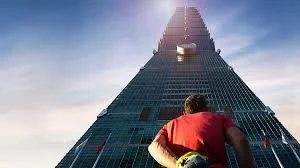
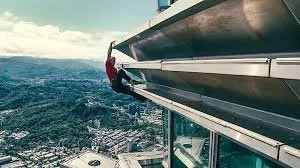

The climb was extraordinary. But so is the surface he climbed.
Taipei 101 is located in Taipei, the capital of Taiwan, in East Asia. When it was completed in 2004, it became the tallest building in the world at 508 meters or 1,667 feet, a title it held until 2010. But height is not what makes engineers pause. Taipei 101 is located in a region subjected to multiple extreme loading conditions. Taipei experiences frequent seismic activity due to its proximity to active fault systems, along with intense typhoon winds and challenging geotechnical conditions. The site is characterized by soft soil layers and a high groundwater table located just below the surface, which significantly complicates foundation design for a supertall structure.
For a building exceeding 500 meters in height, these conditions impose severe demands on lateral stiffness, damping, foundation capacity, and long term structural performance. Taipei 101 was therefore engineered not only to carry gravity loads efficiently, but to safely manage large lateral displacements, dynamic wind effects, and seismic energy dissipation.
From a purely structural standpoint, Taipei 101 was set up for failure.
Concept & Inspiration
Visually, Taipei 101 resembles stacked ancient pagodas, rising in rhythmic segments toward the sky. Structurally, it draws inspiration from bamboo. Bamboo is lightweight yet strong. It bends without snapping. Its joints allow it to dissipate energy instead of resisting it rigidly. This principle is translated into the building through the use of outriggers and belt trusses placed at regular intervals of eight floors. These systems connect the central reinforced concrete core to the perimeter mega columns, allowing lateral forces to be shared across the entire structural system. By segmenting the tower vertically, stresses are redistributed, drift is reduced, and overall stability is enhanced under both wind and seismic loading. This philosophy marked a turning point in skyscraper design. Movement was no longer treated as a failure. It became part of the solution.
Wind Engineering
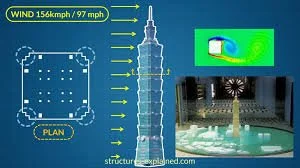
Taipei is located in a high typhoon risk zone, with design wind speeds reaching approximately 156 kilometers per hour for a 100 year return period. At this height, wind behavior becomes highly complex. As wind flows around the building, it separates from the surface and forms alternating vortices along the sides of the tower, a phenomenon known as vortex shedding.
These alternating pressure zones generate oscillating lateral forces that can induce crosswind vibrations and increase dynamic response. Without mitigation, this can lead to excessive sway, occupant discomfort, and long term structural fatigue. Taipei 101 was extensively tested using wind tunnel studies to optimize its aerodynamic form and structural response to these effects.
Core, Mega Columns, and Load Path Strategy
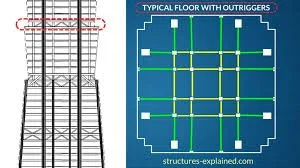
The primary lateral load resisting system consists of a stiff reinforced concrete core combined with eight perimeter mega columns. These mega columns are constructed as steel box sections filled with high strength concrete, providing a composite system that combines compressive strength, ductility, and stiffness.
Under wind and seismic loading, lateral forces are transferred from floor diaphragms into the core and mega columns, then distributed vertically down to the foundation system. The outriggers play a critical role by mobilizing the perimeter columns to resist overturning moments, significantly reducing core demands and overall building drift.
This dual system allows Taipei 101 to perform efficiently under both long duration wind loading and short duration seismic events.
The Energy Dissipating Pendulum
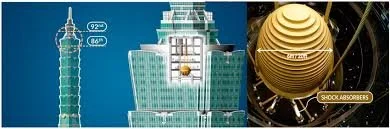
One of the most distinctive features of Taipei 101 is its tuned mass damper system, located between the 86th and 92nd floors. The damper consists of a 726 ton steel pendulum with a diameter of approximately six meters, suspended by high strength cables and connected to hydraulic damping devices. During wind induced or seismic motion, the damper moves out of phase with the building, generating counteracting inertial forces. As the damper oscillates, hydraulic shock absorbers dissipate energy by forcing fluid through small internal orifices, converting kinetic energy into heat. This process reduces vibration amplitude, limits acceleration, and improves occupant comfort.
The damper accounts for approximately 0.24 percent of the total building mass and has been observed to move nearly one meter during severe typhoon events, demonstrating its effectiveness under real world conditions.
Why Taipei 101 Remains a Structural Icon
Taipei 101 represents a shift in supertall building design philosophy. Rather than relying solely on stiffness, the structure integrates controlled flexibility, energy dissipation, and composite structural systems to manage extreme environmental forces.
Its combination of wind engineering, seismic design, damping technology, and nature inspired structural logic has influenced tall building design worldwide. Taipei 101 is not only a landmark of height, but a reference model for how engineering can coexist with some of the most demanding natural forces on Earth.
Alex Honnold’s climb brought global attention back to Taipei 101. Taipei 101 has influenced seismic design strategies worldwide. Its approach to controlled flexibility, damping systems, and nature inspired engineering has become a reference point for tall buildings in high risk zones.
The climb showed what humans are capable of.
The building shows what human ambitions and engineering makes possible.And together, they tell a powerful story about respect for physics, precision, and the forces that shape our world.
