When the World’s Biggest Project Meets Reality
Saudi Arabia’s most ambitious experiment in nation-building is entering a new phase. NEOM, the futuristic mega-city envisioned along the Red Sea coast, is projected to cost between $1.5 trillion and $8.8 trillion over several decades, greatly surpassing the initial estimate of $500 billion. It is now being scaled back considerably after years of soaring costs, engineering complexity, and delivery delays. For a project once pitched as a once-in-a-century rewrite of how cities function, the shift is significant. Yet even in downsizing, NEOM and its sister developments remain among the most consequential construction and infrastructure programs on the planet.
At the center of this recalibration is Crown Prince Mohammed bin Salman and his Vision 2030 agenda, a plan designed to reduce Saudi Arabia’s dependence on oil and reposition the kingdom as a global hub for tourism, technology, entertainment, and advanced industry. According to the Financial Times, the original scope of NEOM is being narrowed to focus on projects that are economically viable and technically feasible within a realistic timeframe. That does not mean Vision 2030 is stalling. It means it is being stress-tested against reality.
NEOM: from limitless ambition to targeted delivery
When NEOM was announced, it was almost impossible to grasp its scale. A development roughly the size of Belgium, packed with smart cities, floating ports, renewable energy systems, luxury tourism, and experimental urban forms, it was designed to be a proof-of-concept for the future of human settlement. Over time, however, the challenges became harder to ignore. Building at this scale in a remote desert region without existing transport infrastructure created a massive logistical strain. Many of the technologies required to make the city function at its promised efficiency remain conceptual.
Recent indications suggest NEOM will now concentrate on areas where Saudi Arabia sees long-term strategic advantage, particularly AI, data centers, advanced manufacturing, and energy infrastructure. Instead of trying to build everything at once, the project appears to be moving toward fewer, denser, and more economically anchored components. The vision is no longer about infinite expansion, but about proving that select pieces can actually work.
The Line: a bold idea meets physical limits
No part of NEOM captured global attention like The Line. A 170-kilometer-long mirrored city with no cars, no streets, and ultra-high-density living, it was marketed as a radical alternative to urban sprawl. But radical ideas still have to obey physics, logistics, and budgets. Reports now suggest the initial phase of The Line could be reduced to just a few kilometers, housing hundreds of thousands rather than millions of residents by 2030.
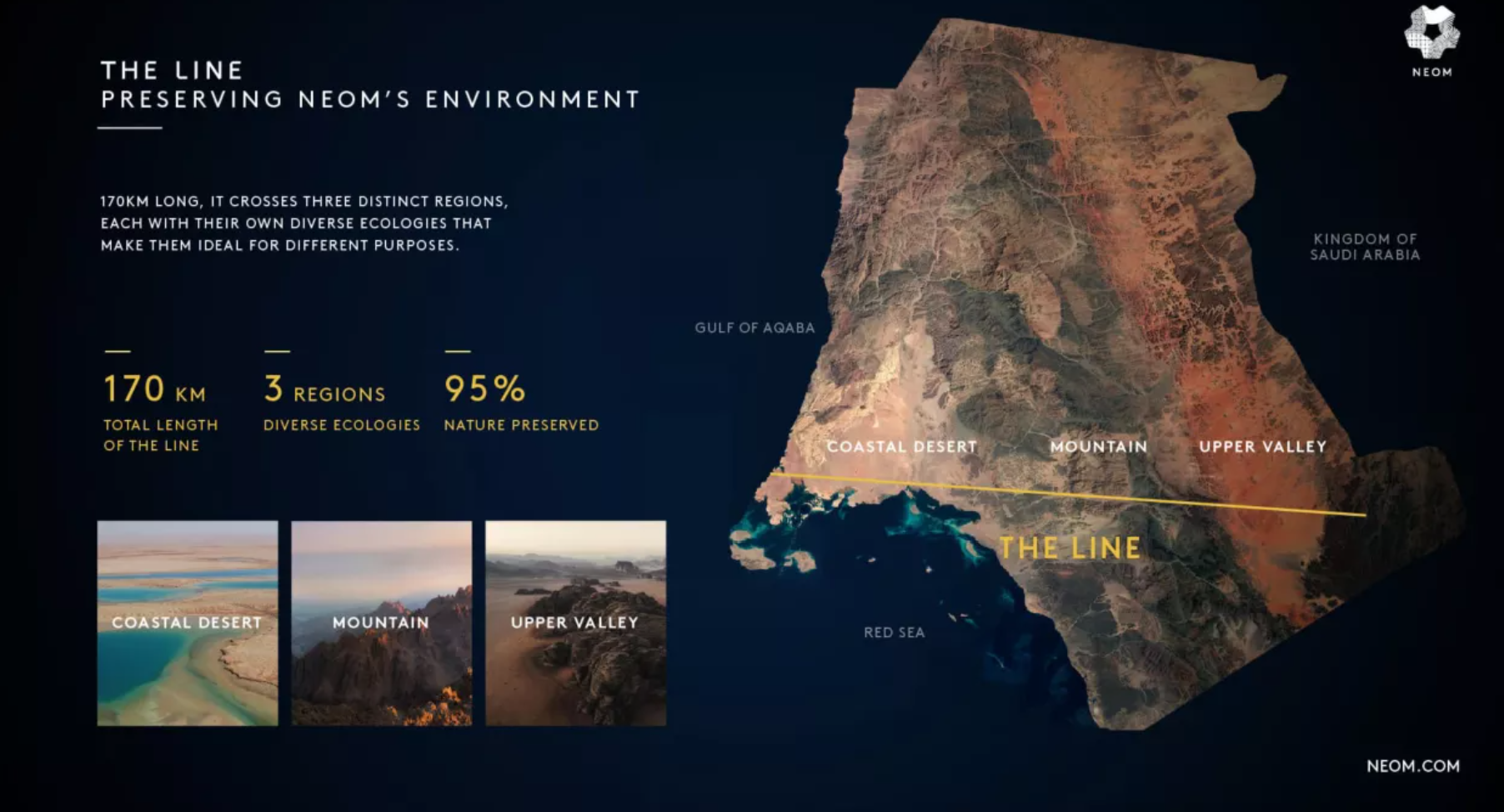
The Line - Concept
The issue is not just cost, though that is substantial. The Line depends on transport, energy, and service systems that have never been deployed at this scale. Even the headline promise of traveling from one end of the city to the other in 20 minutes assumes a transit technology that does not yet exist in practice. Riyadh maintains that The Line could be built incrementally over decades, but the original timeline and population targets are increasingly unlikely.
Trojena: winter sports in the desert, on pause
Perhaps the most visually striking of NEOM’s sub-projects is Trojena, billed as the Arabian Peninsula’s first outdoor ski resort. Selected to host the 2029 Winter Olympics, Trojena was meant to symbolize Saudi Arabia’s ability to defy geography through engineering. In reality, the project has faced escalating costs and construction delays, with estimates rising by more than ten billion dollars.
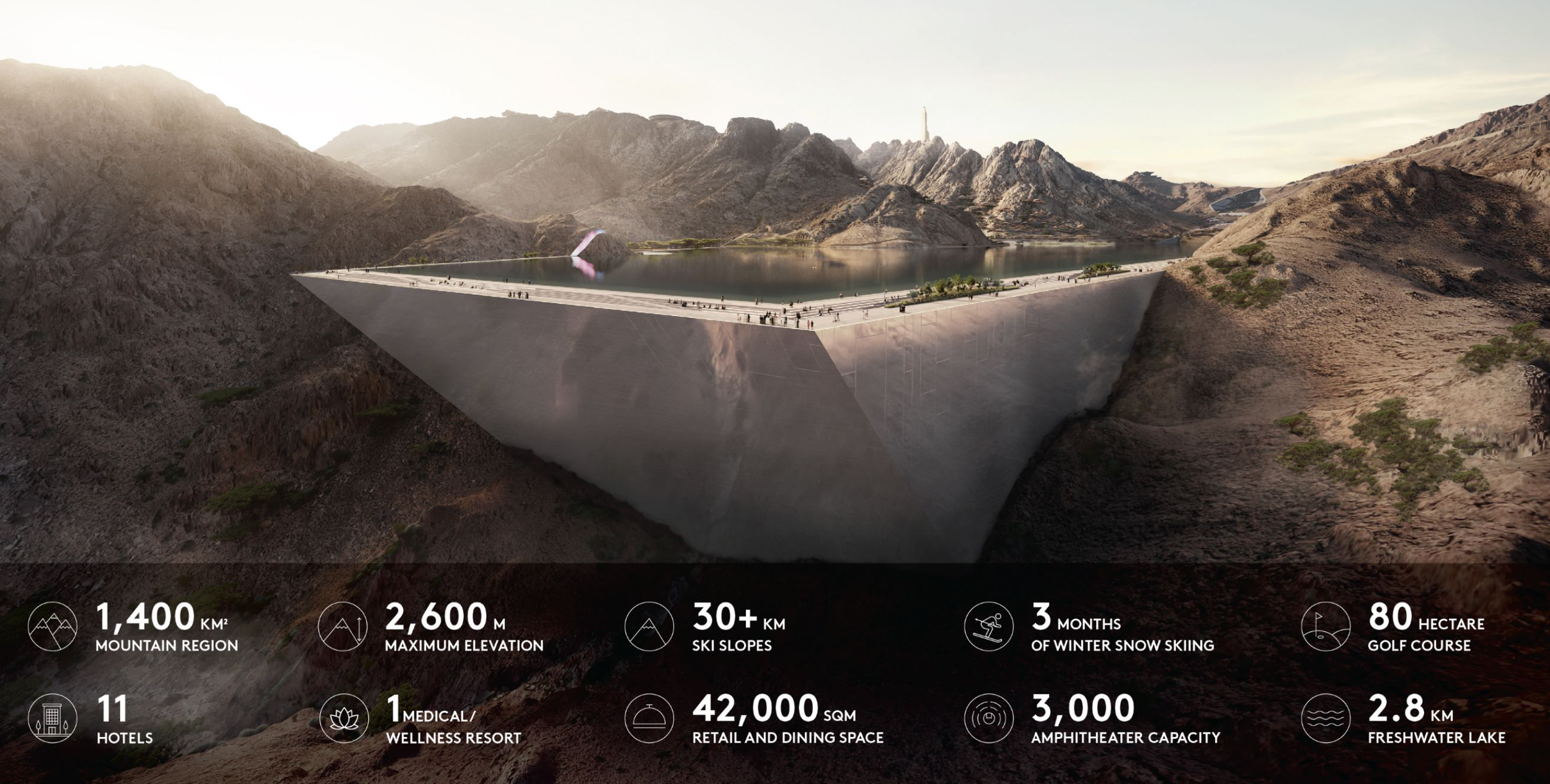
Renderings of Trojena
The postponement of the Winter Olympics has raised questions about the project’s immediate future. While parts of Trojena may still move forward, key elements such as the Sky Village are being downsized. The concept is not dead, but its timeline and ambition are being rewritten to align with what can actually be delivered.
Sindalah: luxury tourism, still waiting to open
Sindalah was positioned as NEOM’s early win. A high-end Red Sea island resort designed to attract global tourists and signal momentum, it was softly launched in 2024 but has yet to fully open. Ongoing delays and management changes have slowed progress, and reports of job cuts suggest the project is being reassessed.
Renderings of Sindalah
That said, Sindalah remains strategically important. Tourism is a core pillar of Vision 2030, and Red Sea destinations are among Saudi Arabia’s most market-ready assets. Whether Sindalah ultimately opens as originally designed or in a scaled-back form, it is unlikely to be abandoned entirely.
Oxagon: NEOM’s industrial heart is still beating
Amid all the recalibration around NEOM’s futuristic urbanism, Oxagon stands out as a rare success story in execution. Designed not as a mirrored city of glass but as a world-leading industrial and logistics hub, Oxagon is being built around one of the most advanced automated port and supply-chain ecosystems ever attempted. It is conceived as an octagon-shaped hub, partly built over the Red Sea, marrying state-of-the-art robotics, automation, AI systems, and clean-energy infrastructure with traditional industry and manufacturing in ways the original megacity concepts never fully did.
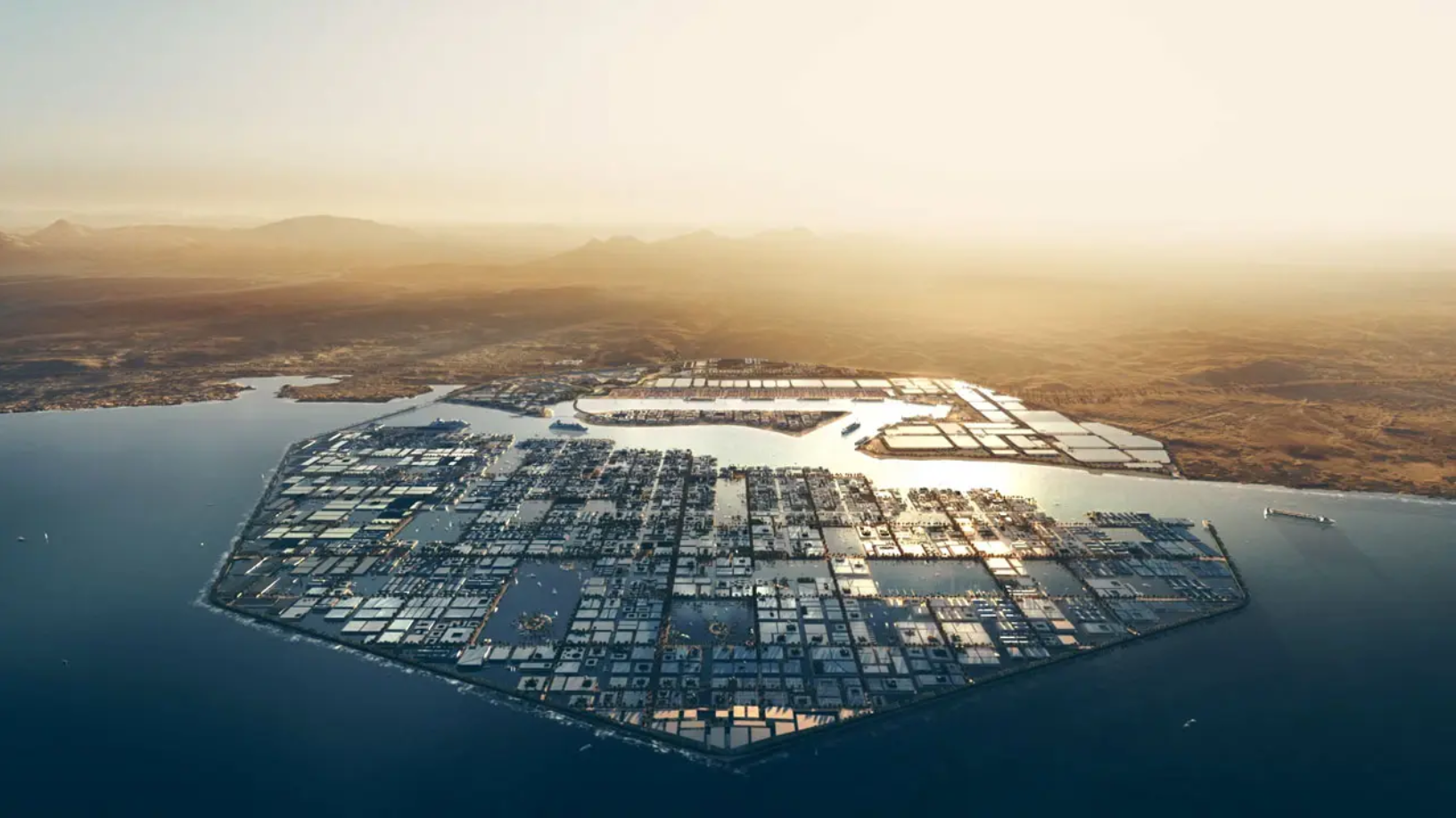
Renderings of Oxagon
Unlike other NEOM components that have struggled under cost pressure and feasibility questions, Oxagon’s core infrastructure has shown steady physical progress. Recent satellite imagery and construction reports highlight measurable expansion of marine works, port facilities, and land reclamation efforts, with multi-phase development well into execution. The port element, in particular, is being framed as a logistics backbone for the Red Sea region and beyond, linking some of the world’s busiest maritime trade routes with a next-generation manufacturing and distribution system
What this really means for the future of mega-projects
NEOM’s downsizing is not a collapse. It is a correction. Vision 2030 is moving from spectacle-driven ambition to execution-driven prioritization. For the global construction and development industry, this shift is instructive. Even state-backed mega-projects with virtually unlimited capital eventually run into constraints of labor, logistics, technology readiness, and time.
What Saudi Arabia is attempting remains unprecedented in scale. Even in its reduced form, NEOM will influence how cities are planned, how infrastructure is financed, and how emerging technologies are integrated into the built environment. The lesson is not that ambition failed, but that ambition is being forced to mature.
For Future Builds, this moment matters. It marks the point where visionary renderings give way to hard engineering decisions. And that is where the real future of building is decided.
